Glimpse into Institute of Protien Design
Got a personal invitation to see the Institute of Protein Design - the lab of AlphaFold.
Exploring the Institute for Protein Design
April 17, 2026 | University of Washington, Seattle
From a Cold Email to an Open House
I first cold emailed the Baker Lab to pursue my interest in the intersection of computational systems biology and protein engineering. I was not expecting much. The email was a shot in the dark, a way to see whether there was any path into the kind of research environment I had been reading about.
What came back was technically a rejection, but it was not the end of the conversation. Instead, I was invited to the Institute for Protein Design (IPD) Open House on April 17. That invitation gave me a firsthand look into a field that aligned closely with my scientific interests.
Exploring the Frontiers of Protein Design
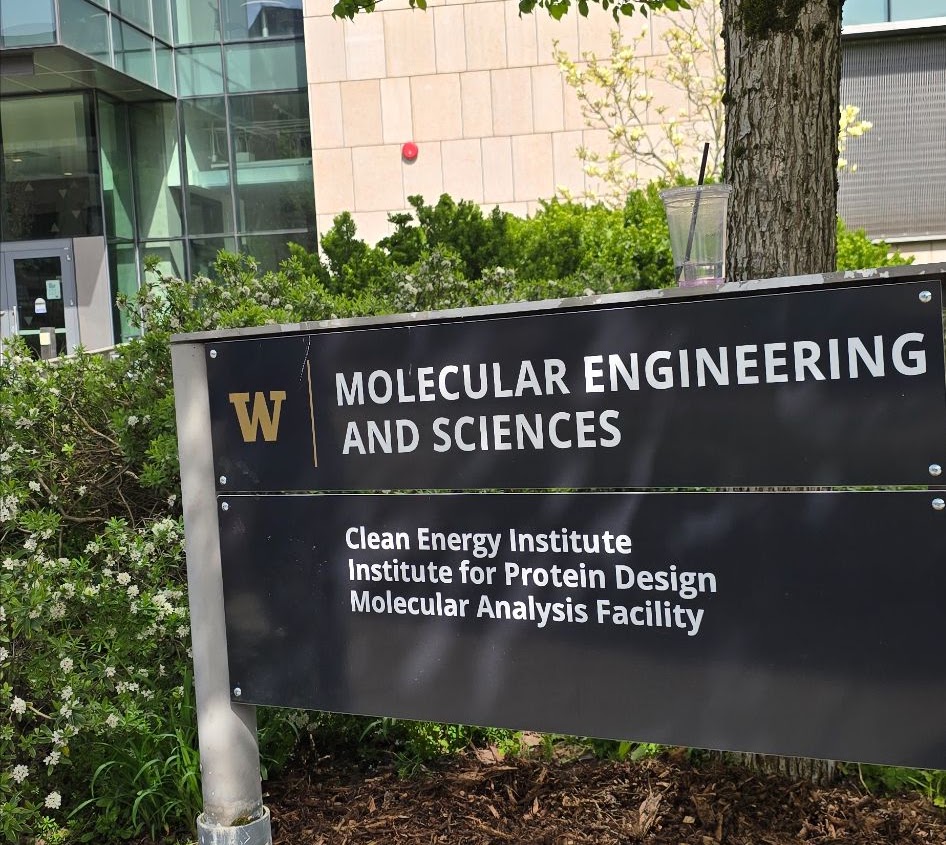
The open house took place at UW’s Molecular Engineering and Sciences Building. Stepping into the conference room and seeing internationally recognized researchers gave me an immediate sense of the scientific environment.
The presentations covered a wide range of topics:
- Computational protein design
- Immunomodulation
- Tau binder design
- Antigen display
- mRNA vaccines
- Enzyme design
- Protein conformational dynamics
Although each speaker focused on a different problem, a common theme emerged: proteins were not treated as fixed structures, but as dynamic systems whose behavior and function could be deliberately engineered.
Engineering Protein Dynamics
The presentation that stayed with me most was Kathryn Shelley’s talk on conformational dynamics. The idea that a protein could be engineered to change its shape in response to light and subsequently return to its original conformation was particularly fascinating.
It demonstrated that protein engineering extends beyond predicting molecular structures. It can also involve controlling structural transitions to produce specific functional outcomes.
This closely aligns with what draws me toward computational systems biology. I want to understand how biological components interact, how those interactions produce complex behavior, and how computational methods can predict and ultimately control those outcomes.
The Architecture of Biological Systems
I also found the antigen display research particularly interesting because it made the design of biological systems feel almost architectural.
The application of octahedral nanoparticles demonstrated how molecular geometry and structural organization could be leveraged to achieve specific biological functions. It reinforced my understanding that biology extends beyond chemistry and genetic sequences into spatial organization, geometry, and system-level behavior.
Touring the Baker Lab
The laboratory tour made these concepts more tangible. Exploring both computational and experimental research spaces demonstrated the importance of integrating dry-lab modeling with wet-lab validation.
Computational design, experimental testing, and iterative refinement formed an interconnected research pipeline rather than separate scientific disciplines.
I also learned about the laboratory’s tradition of 3D-printing protein structures and saw a newspaper commemorating David Baker’s 2024 Nobel Prize in Chemistry.
The experience introduced me to several important computational tools:
- RFdiffusion: Generative protein structure design.
- PyRosetta: Computational macromolecular modeling and protein engineering.
- PyMOL: Molecular visualization and structural analysis.
Reflection
What began as an unsuccessful cold email ultimately became an opportunity to explore one of the leading research environments in computational protein design.
Beyond learning about specific technologies, the experience strengthened my interest in understanding biological systems through computational modeling, mathematical reasoning, and experimental validation.
I left with a clearer sense of the research direction I wanted to pursue: understanding complex biological systems not only to predict their behavior, but eventually to engineer and control it.
Gallery